A Food Production Engineer's Glossary: Hygiene and Technical Standards You Need to Know
Contents:
- Foundations of a modern plant: why detail engineering matters
- Steel grades in the service of hygiene
- DIN 9797 — the universal language of logistics in a food plant
- Designing to the HACCP standard
- HoReCa and industry
- Engineering that builds an advantage
Foundations of a modern plant: why detail engineering matters
In the food industry, where hygiene standards and process efficiency decide business success, plant equipment is no longer just a „collection of machines and tools”. It becomes a critical link in the food safety chain. Every weld, every surface finish and every choice of a specific steel grade has a direct impact on how easy it is to maintain hygiene (HACCP) and on the reliability of the production line.
At P.P.H.U. TRACZ we have been guided for years by the principle of „engineering tailored to your needs”. This means we base our designs on hard technical data and European standards — for many these are just numbers, but for us they are a guarantee of durability. In this article we explain the key concepts and material standards we apply to deliver solutions that withstand the test of time and the demanding working environment of the food, bakery and hospitality industries.
Steel grades in the service of hygiene: choosing the foundation of production
Modern metallurgy has catalogued hundreds of steel grades, each with a unique chemical composition and specific numerical designation. Our attention, however, is focused precisely on the group of materials that meet the strict standards for food contact. We concentrate on alloys dedicated to gastronomy and the food industry — materials that must cope with extreme challenges: constant humidity, extreme temperatures, and the aggressive action of the chemicals used in washing and disinfection processes.
The choice of a specific designation is never accidental for us; it is the result of a thorough analysis of the environment in which the equipment will operate. In everyday engineering practice we work primarily with two key grades:
AISI 304 (1.4301) — the gold standard of the food industry
This is the most widely used stainless steel grade in our plant. Its popularity comes from an excellent balance between corrosion resistance and suitability for precise mechanical processing.
- Properties: the high chromium and nickel content forms an invisible passive layer on the metal surface that effectively protects against oxidation under standard processing conditions.
- Applications: the ideal material for our flagship stuffing trolleys (compliant with DIN 9797), cutting tables and internal transport components. It is fully biologically inert, which means it does not affect the organoleptic properties of food.
AISI 316 (1.4401) — the solution for special tasks
When plant conditions become more demanding — for example when processing highly salted products, or where strong chlorine-based detergents are used — we reach for a steel with enhanced parameters.
- Properties: thanks to the addition of molybdenum, grade 1.4401 shows significantly higher resistance to pitting and crevice corrosion, especially in chloride-rich environments.
- Applications: we use it for specialised curing vats, brine tanks and equipment operating in the most aggressive processing environments.
By using precise numerical designations (1.4301, 1.4401) instead of colloquial terms, we give our customers an engineering guarantee. They know exactly what material arrives on their production floor and what service life they can expect from it. This material knowledge is what allows us to deliver on our promise of „engineering tailored to your needs”.
DIN 9797 — the universal language of logistics in a food plant
In industrial engineering, standards exist so that different elements of a system can work together without friction. In the meat and food processing industry, that „common language” is the DIN 9797 standard. It sets out strict guidelines for the construction of transport trolleys (commonly known as stuffing trolleys), which are the heart of internal transport in almost every modern plant.
Why is DIN 9797 so important?
For an engineer and a plant owner, this standard means above all full compatibility. TRACZ trolleys (with capacities of 120 L, 200 L and 300 L) are designed with millimetre precision to work perfectly with peripheral equipment:
- Lifting and tipping systems: thanks to standardised side handles, every one of our trolleys fits mast and column lifting devices from any manufacturer who also follows DIN 9797.
- Line modularity: standardisation makes it easy to replace a trolley fleet or expand the machine park without worrying whether „the new equipment will fit the old”.
Detail engineering in the service of the standard
Compliance with DIN 9797 is about more than overall dimensions. At TRACZ we take care of the technical details that follow from this standard and that determine safety and durability:
- Reinforced base and rim: the structure must withstand enormous loads during lifting and rapid emptying.
- Specialised wheel layout: precise wheel placement makes the trolley easy to manoeuvre even under full load — crucial for work ergonomics.
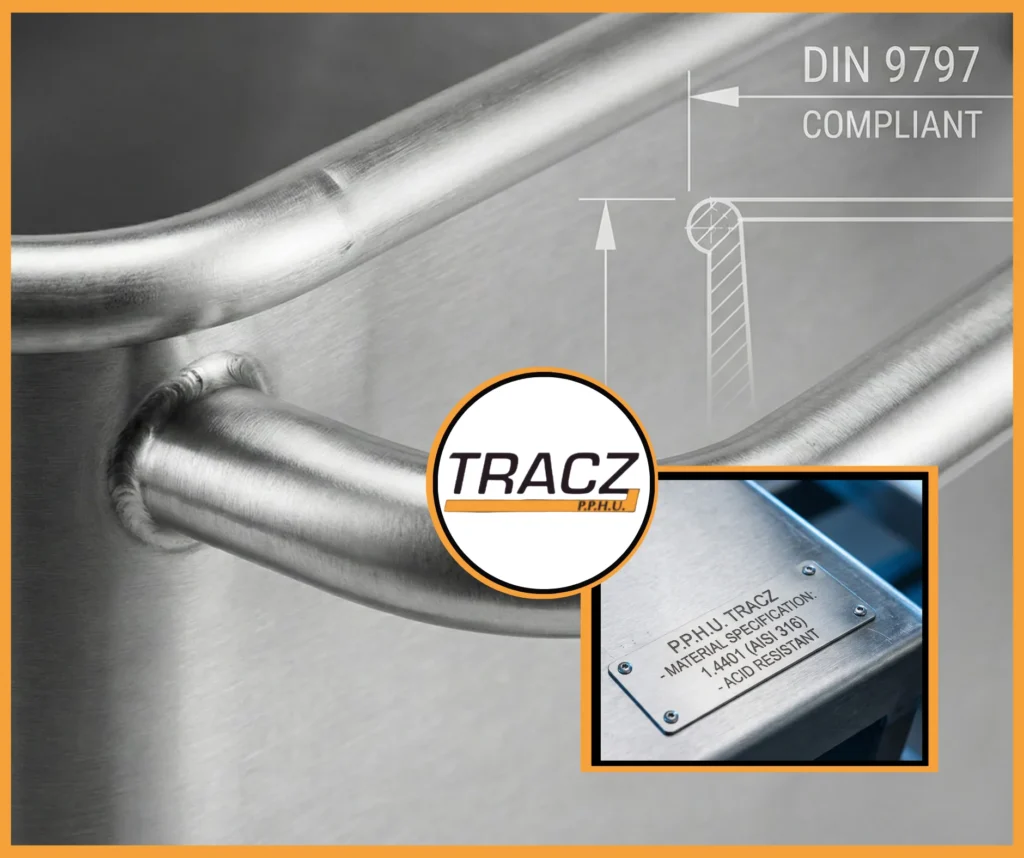
- Hygienic finish: the standard requires specific sheet-bending radii which, combined with our continuous-weld standard, eliminate the risk of product residue build-up.
By investing in DIN 9797-compliant solutions you gain certainty that your internal transport system is universal and ready for future upgrades. This predictability is what turns tailor-made engineering into a real advantage in day-to-day production management.
Designing to the HACCP standard: hygiene built into the structure
In the food industry, HACCP (Hazard Analysis and Critical Control Points) is usually associated with documentation and rigorous procedures. For TRACZ engineers, however, HACCP is first and foremost a set of design guidelines. We believe food safety begins at the drawing board — if a piece of equipment is badly designed, no washing procedure will ever guarantee full hygiene.
Engineering out the hazards
When designing our stainless steel equipment, we focus on eliminating so-called „hygiene traps”. Here is how we translate safety theory into workshop practice:
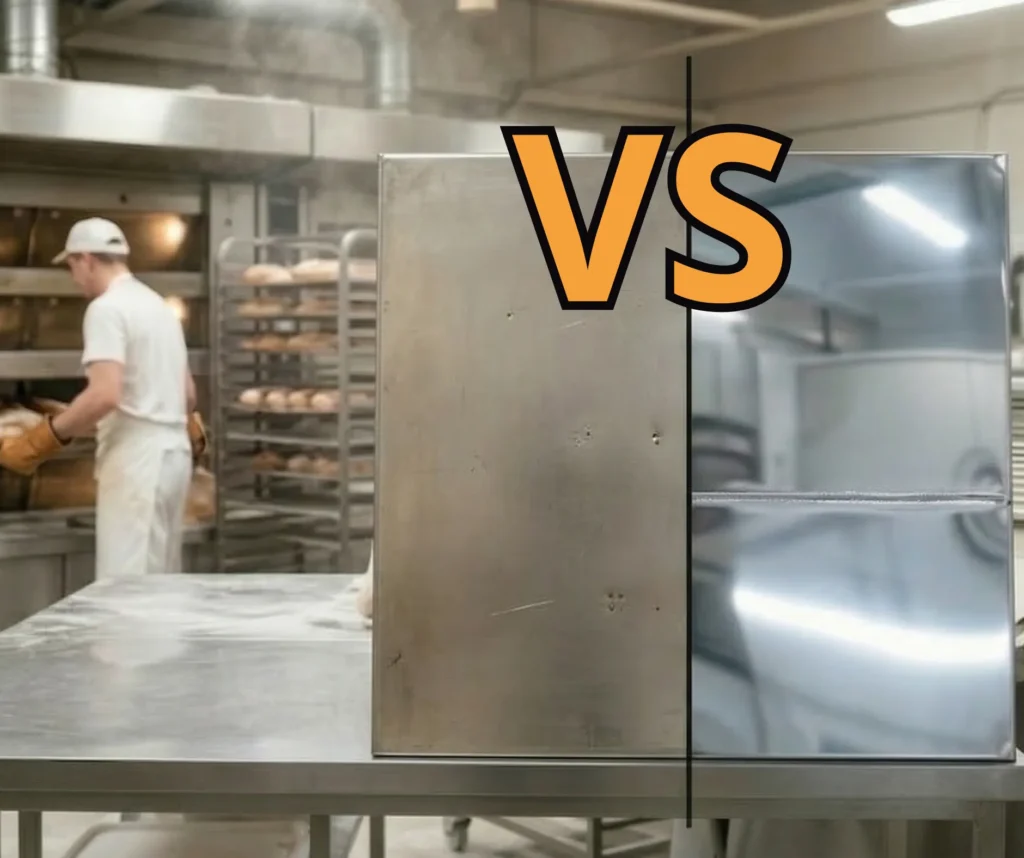
- Continuous, ground welds: unlike cheaper solutions based on spot welds, we use continuous welds which are then precisely ground to a perfectly smooth surface. This eliminates the micro-crevices where bacterial colonies could develop.
- No „dead zones”: our tables, vats and trolleys are designed without sharp internal corners or recesses that a pressure-water jet or disinfectant cannot reach. Appropriate sheet-bending radii force contaminants to drain away naturally.
- Closed profiles and sealed finishes: all structural elements, such as table legs and trolley frames, are tightly sealed. This prevents water from entering the profiles, which could lead to internal corrosion and secondary contamination of the production hall.
Benefits for the plant: time is money
Applying the principles of hygienic engineering brings measurable economic benefits:
- Shorter washing times: smooth surfaces and the absence of recesses allow equipment to be brought to a state of microbiological cleanliness much faster and more effectively.
- Lower utility consumption: more effective washing means less water and less specialised industrial chemistry.
- Confidence during inspections: equipment designed to hygienic standards is the strongest argument during sanitary and veterinary audits.
At TRACZ we accept no compromises in finishing. We know that a detail invisible at first glance can determine the safety of an entire batch of our customer’s goods. That is the foundation of „engineering tailored to your needs”.
HoReCa and industry — flexible solutions at every scale
TRACZ engineering is, above all, flexibility. Our material knowledge and decades of experience with stainless steel allow us to deliver solutions that perform in radically different environments — from professional hotel kitchens to vast meat, bakery and vegetable processing halls. The key is understanding that while the scale of projects changes, quality standards do not.
Precision for the HoReCa sector
In the hotel and catering segment, what counts is optimal use of space and absolute hygiene combined with high aesthetics. Gastronomy tables, storage racks and „rollie” transport trolleys must be light and ergonomic, yet extremely durable. Thanks to grade 1.4301 (AISI 304) steel, our HoReCa products not only meet strict sanitary standards but also keep an impeccable appearance through years of intensive use in humid, frequently washed environments.
The power of scale: industry and processing
For industrial plants we design equipment with enhanced resistance to extreme mechanical and chemical loads. In this area our engineering focuses on process efficiency and full integration:
- Meat plants and slaughterhouses: we supply transport systems and trolleys compliant with DIN 9797 — the foundation of internal logistics.
- Fruit and vegetable processing: we use 1.4401 (AISI 316) steel wherever contact with organic acids demands the highest anti-corrosion barrier.
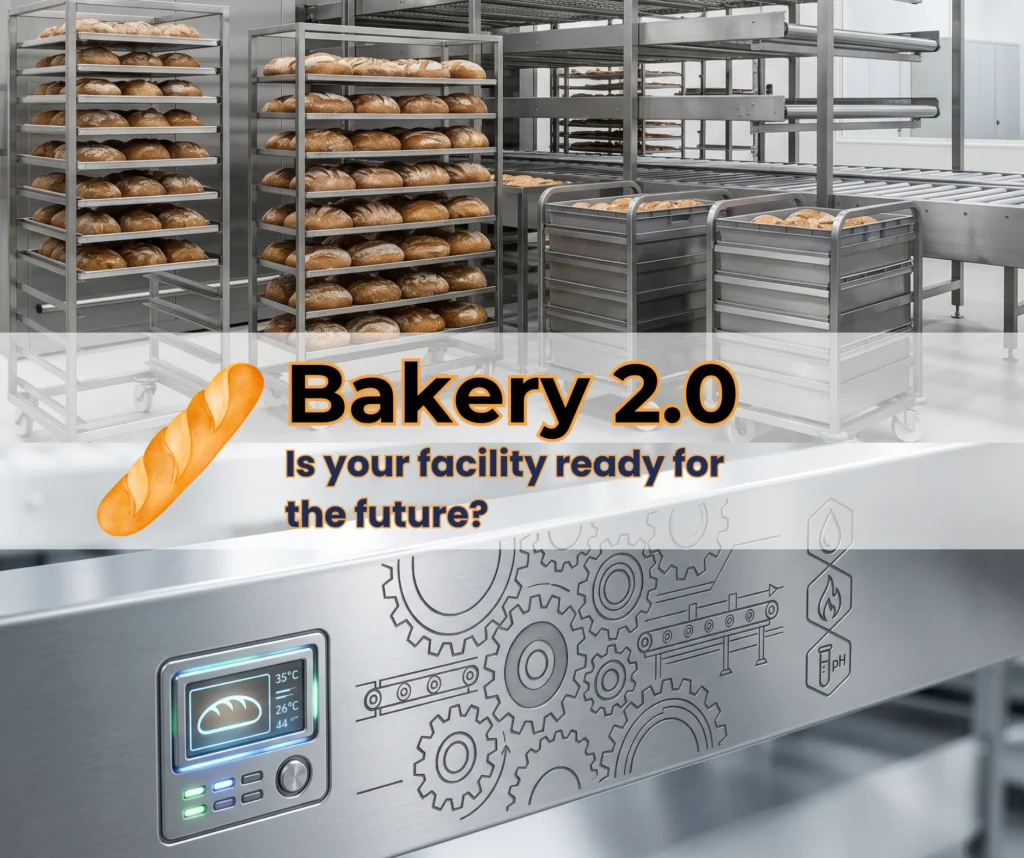
- Bakeries: we build mobile racking systems and trolleys that must maintain structural rigidity across changing temperatures.
Whether your goal is to equip a small laboratory or modernise the machine park of a large production plant, our slogan „engineering tailored to your needs” means exactly the same thing: a product precisely matched to the specifics of your work. We do not speculate — we analyse your production process and deliver stainless steel solutions that simply work.
Engineering that builds an advantage
Choosing stainless steel equipment is an investment that goes beyond an ordinary purchase. It is a decision about the hygiene standard, working pace and safety of the entire plant. We believe that understanding the differences between 1.4301 and 1.4401 steel, strict compliance with DIN 9797 and designing in the spirit of HACCP are the only way to create systems that genuinely support our customers’ growth.
Whether you run a large meat plant, a modern bakery or a professional hotel kitchen, our approach remains the same: we deliver engineering that is not afraid of difficult conditions or the passage of time.
Build your plant’s standard with us
Need advice on selecting the right steel grade for the specific processes in your company? Or are you looking for transport solutions that will integrate 100% with your production line? Browse our product catalog or contact our technical advisors — together we will design tailor-made solutions that raise the efficiency and hygiene standard of your business.