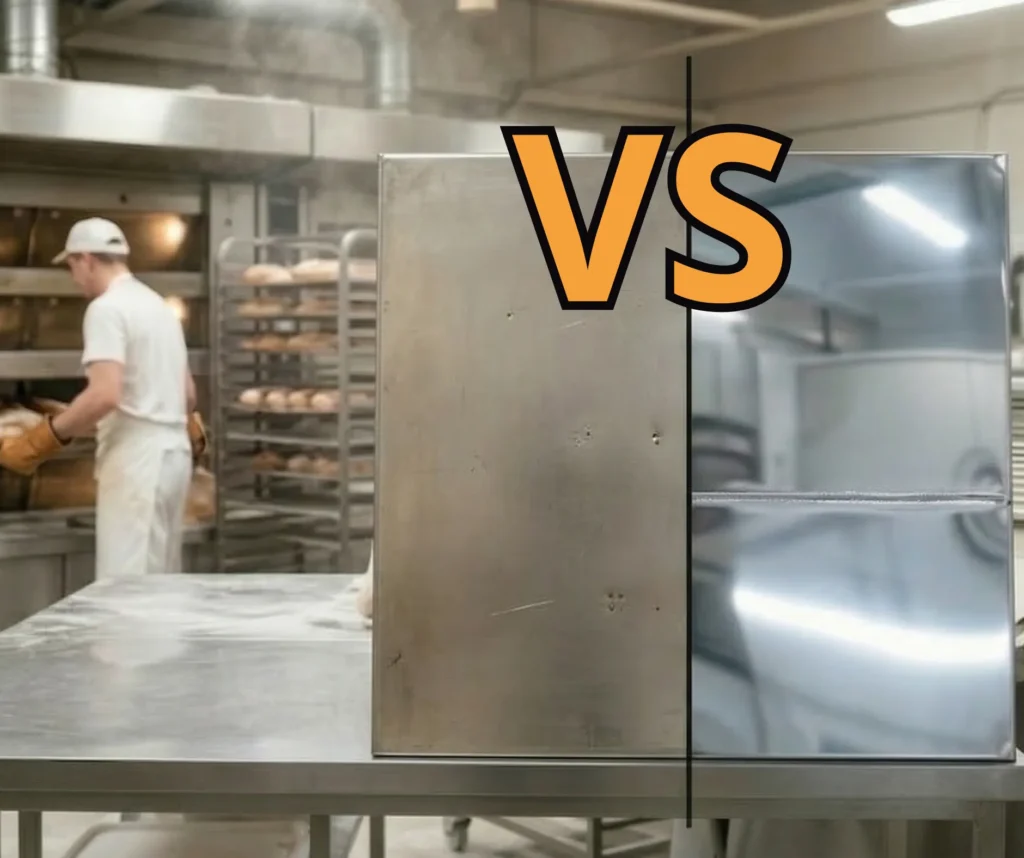
Stainless steel vs. Alusteel (aluminum steel) – what will really survive in your bakery?
Contents:
Seeming savings or an investment for years? What is Alusteel and how does it compare to stainless steel? Hygiene and aggressive cleaning – where does Alusteel start to cause problems? TCO economic analysis – how much does your trolley really cost? Tailor-made engineering – let’s start with a joint conversation When the premium standard becomes a necessitySeeming savings or an investment for years?
Running a modern bakery is a constant balance between cost optimization and maintaining the highest quality of the product. When planning equipment – shelves, transport trolleys or other accessories – each owner faces the same question: choose a cheaper solution „for now”, or to invest in equipment that will survive decades?
In the bakery industry, we often come across a material with a trade name Alusteel (aluminum steel). At first glance, it looks solid – and no wonder, since it was designed to work in high temperatures – and its lower price can be tempting with large orders. However, there is no shortcut in engineering. What seems to be a savings when buying is often a generator of hidden costs after just a few months of intensive use.
in P.P.H.U. Based on our experience since 1987, we know that a bakery trolley is not only a „frame on wheels”. It is a key element of the production chain that must work flawlessly in extreme conditions: from freezers, through wet pots, to heat of rotating furnaces.
In this article, we will break down the differences between stainless steel and aluminized steel into prime factors, so that you can make a decision based on hard technical data, not only on the numbers in the offer. Because ours „Tailored Engineering” It begins where others seek compromises.
What is Alusteel and how does it compare to stainless steel?
Before we move on to practice, we need to understand the foundation: what are these materials really made of? The difference is not in the appearance (because they both shine similarly at the beginning), but in their internal structure.
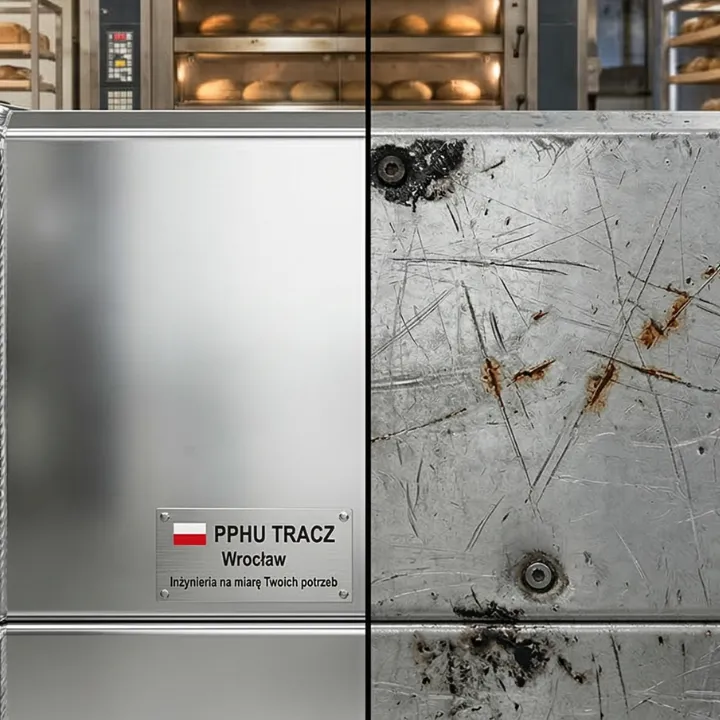
ALUSTEEL (aluminum steel) – sandwich material
Alusteel is the proprietary name of the technology developed by ArcelorMittal. Aluminum steel is, to put it simply, plain carbon steel (black), which has been covered on both sides with a thin layer of aluminum alloy (approx. 90%) and silicon (approx. 10%).
- How does it work? The coating is to protect the corrosion-prone core against external factors.
- Theoretical advantage: Thanks to the admixture of silicon and the aluminum layer, Alusteel phenomenally reflects heat (even up to 80%) and is stable at temperatures up to approx.. 450 ° C No discoloration. This makes it a great choice for baking sheets or heat screens.
- Where is the risk? The effectiveness of Alusteel ends when the shell is broken. A deep scratch, impact with a sheet metal rim or welding processes reveal 'ordinary’ steel, which in the humid environment of the bakery begins to rust from the inside. In the case of the construction of a trolley that works in constant motion, damage to the coating is inevitable.
Stainless Steel – Uniform Alloy Strength
In the case of our products, we are talking about a homogeneous material in its entire volume. Stainless steel does not have any coating that could chip off or rub off.
- Why is it 'stainless’? Due to the high chrome content, an invisible, self-healing layer of oxides is created on the surface of the steel. If you scratch a stainless steel trolley, this layer will immediately rebuild itself under the influence of oxygen from the air.
- Engineering application: When choosing stainless steel, you choose a material that is as resistant to the outside and inside.
The key difference for your bakery: The transport trolley made of Alusteel is a product 'for the first deep scratch’. A stainless steel trolley is an investment that retains its anti-corrosion properties and aesthetic appearance even after years of intensive use, hitting the walls or hundreds of washing cycles.
Hygiene and aggressive cleaning – where does Alusteel start to cause problems?
In a modern bakery, cleanliness is not only a matter of aesthetics, but above all the food safety requirement (HACCP). The choice between stainless steel and Alusteel (aluminum steel) is most clearly visible at the time of washing and disinfecting the equipment.
Sensitivity to chemistry – „blacking” of aluminum steel
Aluminum steel (Alusteel) has one key weakness: it reacts very violently with many professional detergents used in the food industry.
- Chemical reaction: If you use alkaline (alkaline) detergents for cleaning, the aluminum layer on the surface of the trolley may begin to oxidize. The silicon contained in the coating, although it improves the adhesion of the alloy to the steel, does not protect it against the aggressive effects of strong washing agents.
- effect? The equipment is covered with a dark, dirty coating (the so-called blackening), which not only looks unsightly, but can dirty the hands of employees, and even worse – transfer to products or cakes. In the food industry, where white aprons and sterility are the norm, this is a disqualifying defect.
Stainless steel – resistance to „chemistry” and moisture
Our stainless steel constructions are chemically inert to most standard disinfectants and washing agents.
- Process strength: You can use active foams and hot water under pressure without worrying about damaging the structure of the material.
- Biological indifference: Stainless steel does not react with organic acids (e.g. made of sourdough cakes) or with high humidity in the pots.
The problem of microcracks and splashes
In bakeries with high turnover of goods, transport trolleys are constantly exposed to impacts. In the case of AlusTeel, any stronger impact against the sheet metal can cause a microcrack in the aluminum coating. Under the influence of water vapor and temperature, a corrosion focus quickly appears in these places, which is impossible to clean and becomes a habitat for bacteria.
Summary for the technologist: Stainless steel offers a smooth, non-porous surface that is very easy to disinfect. By choosing transport trolleys or shelves from a manufacturer using a pure 'stainless’ you eliminate the risk that your machinery will become a 'bottleneck’ during sanitary inspection.
TCO economic analysis – how much does your trolley really cost?
The price on the purchase invoice is only the tip of the iceberg. You will know the real cost of the equipment only after several years of its operation. Exactly that TCO (Total Cost of Ownership), that is, the total cost of ownership shows the difference between „cheap purchase” and „wise investment”.
Although the AL-SI coating in the Alusteel material provides great thermal reflection, which is suitable for small accessories, in the construction of trolleys, its low mechanical resistance drastically shortens the life cycle of the product. Instead of reading about the differences, take a look at a hard statement of facts:
| Feature | Stainless steel | Aluminum steel |
|---|---|---|
| Expected viability | 15-20 years and more | On average 2-4 years |
| corrosion resistance | total (also on welds) | Only for the first scratch or damage to the coating |
| Reaction to chemistry | indifferent (no discoloration) | Risk of 'blacking’ and oxidation of aluminum |
| rigidity | High (no deformation) | Susceptibility to microfibers and 'shaking’ |
| HACCP security | No risk of chipping and peeling | the risk of peeling of the protective layer |
| Cost on a scale of 10 years | one-off purchase | Necessity of 3-4 times equipment replacement |
| residual value | high (steel retains value) | Virtually zero (cost of disposal / scrap) |
Economic verdict: When choosing a trolley made of AluSteel, you pay less today, but you fund yourself a „subscription” for equipment replacement every few years. The investment in stainless steel from Tracz returns after the first „exchange” that your competitor has to make, and you – no.
Tailor-made engineering – let’s start with a joint conversation
We know very well that each bakery has its own rhythm, its soul and a unique history. For over 35 years of presence in the industry, we have learned one, the most important thing: the best solutions are not created at the drawing board, but during the conversation. Our password ’Tailored Engineering’ For us, it is primarily a readiness for dialogue. We do not want to impose ready-made products from the catalog if we feel that your plant needs something else.
How do we approach cooperation?
- We listen to your needs: Before we propose a specific model of a trolley or a rack, we want to understand what your working day looks like. Where do bottlenecks appear? What do your employees struggle with on a daily basis? You are the expert in your bakery – we are here to provide you with tools that will make your life easier.
- Joint design without compromise: If your space is unusual, has low ceilings or requires a specific arrangement of guides, we sit down to analyze together. It is here that stainless steel shows its greatest advantage over coated materials Alusteel. In the case of Alusteel, each cut or weld disturbs the AL-SI protective layer, opening the way of corrosion. Our stainless steel structures are uniform throughout the structure, which allows us to modify and precisely welding without the risk of weakening corrosion protection. Our engineers will prepare designs and visualizations so that you can be sure that the final product will fit to the millimeter.
- Advice instead of selling: Sometimes the simplest solutions are the best. Thanks to many years of experience, we are often able to suggest a modification that will not only improve logistics, but also optimize investment costs. Our goal is to build lasting relationships, not a one-time transaction.
Compatibility with respect for tradition
We understand that you have your favorite machine park – stoves and systems you trust. Our task is to make the new stainless steel equipment perfectly harmonized with what you already have. Regardless of the brand of stoves or the size of the sheets, we try to adjust our structures so that the work in your bakery becomes simply smoother.
We believe that a partnership approach and mutual trust are the only way to create a bakery that will serve the next generations. We invite you to a casual conversation – tell us about your vision and we will consider how we can implement it together.
When the premium standard becomes a necessity
Choice between stainless steel and solutions Alusteel It is actually a decision on what foundation you want to build the everyday life of your bakery on. Is it supposed to be a way of constant replacement and ad hoc repairs, or rather a path of peace, predictability and the highest hygiene standards?
Although aluminum and silicon alloy (Al-Si) technology finds its legitimate use in specific heating elements, in the case of the logistic 'steering’ of a bakery – trolleys and racks – stainless steel is the only material that guarantees full Sterility and mechanical resistance.
in P.P.H.U. We believe that quality defends itself – not on the day of purchase, but after years of trouble-free operation. We also know that every investment must have an economic justification, so we try to make our stainless steel solutions a real support for your profitability, not just another item in the budget.
Why is it worth taking this step with us?
- You gain time: Solid equipment means less breakdowns and much easier to keep clean without the risk of 'blacking’ the surface.
- You build prestige: Aesthetic and sterile stainless steel is a showcase of a modern plant that builds trust in your audience.
- You sleep peacefully: You can be sure that your equipment meets the most stringent food safety standards (HACCP).
’Tailored Engineering’ This is a promise for us that you will not be left alone with a choice. If you are wondering which solutions will work best in your particular case, just let us know. We will be happy to share our knowledge, analyze your needs and together we will look for the optimal solution – without pressure and in a friendly atmosphere.
Your bakery deserves equipment that will keep up with your passion. We invite you to contact our team in Wrocław. Let’s talk about what we can build together.